01 / Context & objective
The question behind the build.
A list of payments does not explain who owes whom. Shared spending also needs groups, split rules, balances, and a record of settlements.
The objective
Bring expense entry and group balances into one understandable interface, with a backend that keeps those relationships connected.
The solution
The React client connects to a Node.js and Express API backed by MongoDB. The documented features include equal splits, group management, balance dashboards, debt simplification, and settlement history.
02 / How it fits together
A view of the system.
- 01React / shared context
- 02Express REST API
- 03Controllers / Mongoose models
- 04MongoDB
03 / Engineering considerations
The decisions that matter.
Separate UI from API access
The client organizes pages, reusable components, context, hooks, and services. Balance and form behavior have dedicated hooks.
Model groups and settlements explicitly
Users, groups, expenses, and settlements have separate API resources. Group balances are exposed through a dedicated endpoint.
Turn records into useful balances
Equal splits and debt simplification make the dashboard useful beyond recording transactions. Settlement history keeps paid balances traceable.
The challenge
A useful balance view must stay consistent as expenses and settlements change. The important boundary is between the original records and the balances calculated from them.
04 / A closer look
From idea to implementation.
The backend separates routes, controllers, models, and configuration. The frontend separates Expense, Balance, Group, Layout, and general UI components. The README also documents INR support and switching between users.
GET  /api/groups
GET  /api/groups/:id/balances
GET  /api/expenses
GET  /api/settlements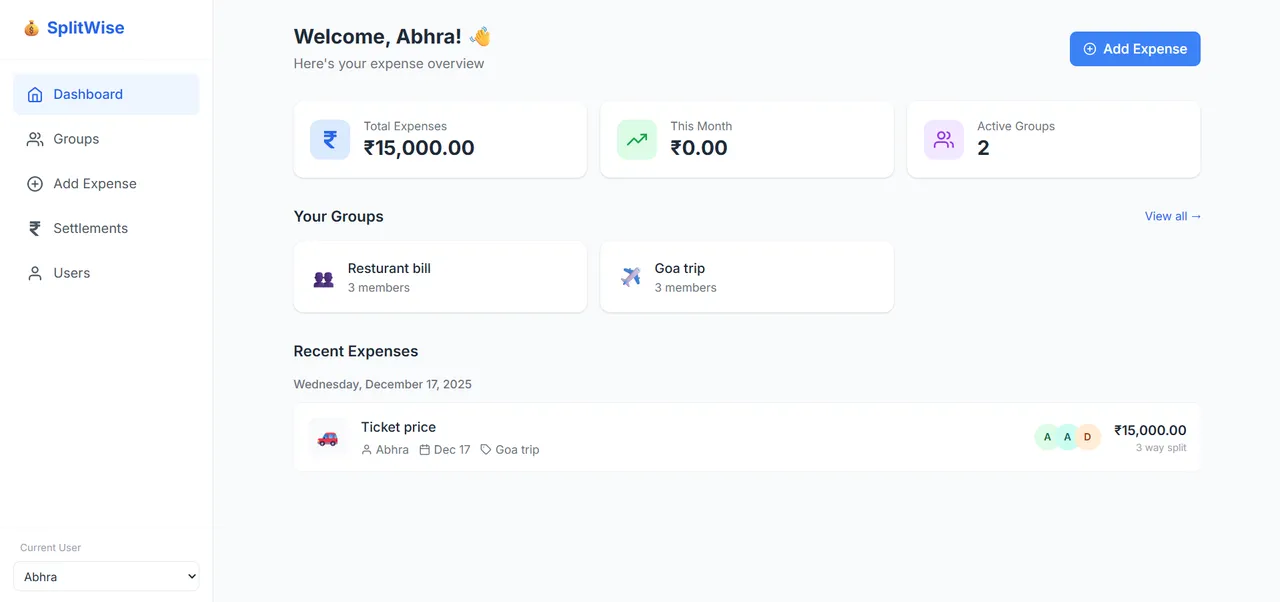
05 / What the work shows
The result. The next question.
A completed portfolio application with source available for inspection. It brings interface design, API organization, and relational application logic together; no live-user or financial accuracy metrics are claimed.
Implementation details summarized from the public README. No hosted demo was supplied in the original portfolio. Read the project documentation (new tab) ↗